CThe Conjuring HouseThe Official Website · Est. 1736

Do You Dare To Know More

The portrait has been listening

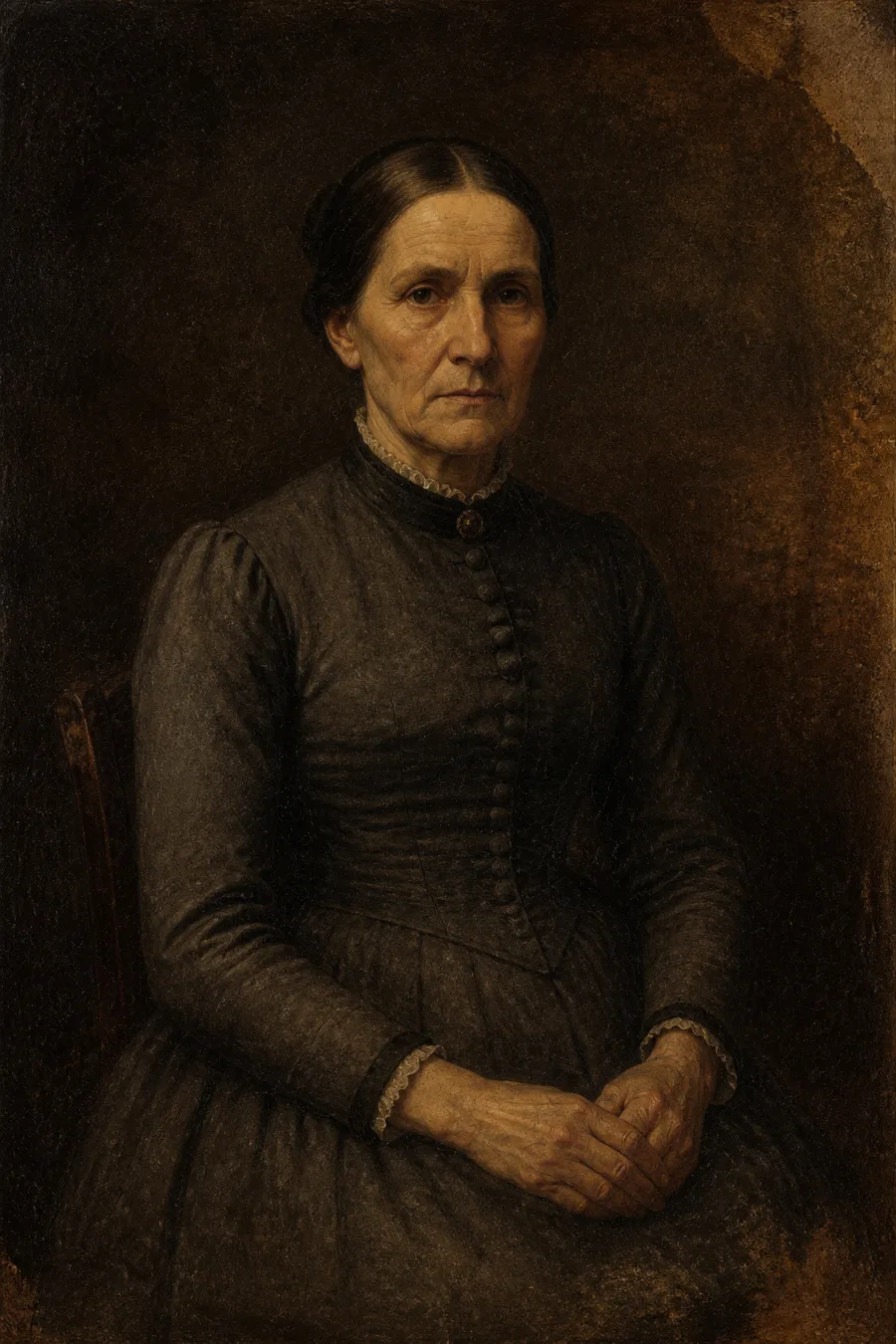
Everyone who comes here wants to see her face, so here is the first true thing: no authenticated portrait of Bathsheba Sherman exists anywhere, and the face the world pictures was invented by people who never met her. The painting below was made for this page and is a likeness of nobody. What it has to say, though, is drawn from deeds, town records, obituaries, and court filings — the 1680 survey, the eight generations, the deaths that really happened on this land and the ones that did not, the Perron decade, and the extraordinary legal fight going on over this house right now. It speaks one passage at a time and stops to ask whether you want the next one.

15 passages · it waits for your answer

An aged 19th-century-style oil portrait of a severe woman in a dark high-collared dress, seated with her hands folded, painted in the manner of a provincial New England portraitist.

Not a likeness of any real person. No authenticated portrait of Bathsheba Sherman is known to exist — this one was made for this page.

The Portrait Speaks

01 / 15

Do you dare to know the true history of this house?

Read it all at once

In Plain Text

The whole account

The same account, with the lights on and nothing withheld. Dates and filings below are as recorded in public documents and contemporary reporting. Where a party has alleged something that no court has decided, it is described as an allegation and attributed to whoever made it.

The portrait is not who you think

You came to look at her face. Sit down — I have something to tell you first, and you will like me less for it.

There is no known portrait of Bathsheba Sherman. None. Not in a museum, not in an attic, not in the town records. Every face you have ever seen attached to that name was made by someone who never met her, long after she was in the ground.

I am paint on cloth. I am not her. But I have hung in the dark of an old house long enough to have learned what actually happened here, which is stranger than the version you arrived with.

1680 — The land, before the house

Begin before the walls. In 1680 a colonist named John Smith walked this ground with a chain and a compass and wrote it down, and the tract was deeded to the Richardson family — wilderness at the far edge of the Providence Plantations, cut out of a much larger grant.

Fifty-six years of nothing. Then, in 1736, they raised the frame around a central chimney, and the beams they set that year are the beams above you now. Not a reconstruction. Not a set. The same wood.

The 1800s — Eight generations

Eight generations of one extended family, on one farm, long enough that the neighbors stopped using the builder's name and called it the Old Arnold Estate — which it is still called, though no Arnold has held the deed in living memory.

They farmed it, laid the stone walls by hand, and buried their dead in the plot among the trees. That is the part visitors feel before anyone says the word ghost: a century and a half of people who were simply at home here.

1901–1911 — The deaths, kept where they happened

One. In 1901 a man named Jarvis Smith froze to death in a rickety shed on this property after drinking. His is the only death the records place on this land, and no one tells his story, because it is merely sad.

The two you have heard about happened elsewhere. Edwin Arnold died of exposure in 1903, found a mile and a half down the road leaning against a stone wall. His son John A. Arnold died in 1911 at his own home near Tarkiln, miles southeast. Every retelling quietly moves them indoors. The record keeps them outside, in the cold, where they died.

1885 — Bathsheba Sherman, in the record

Bathsheba Sherman was born to Ephraim Thayer and Hannah Taft. She married Judson Sherman and moved to the Sherman farm — not this one, never this one — and she lived out her life there. She died on the twenty-fifth of May, 1885, of what the record calls sudden paralysis. A stroke. She is buried in Harrisville.

There is no document in existence naming her a witch. None connecting her to the death of any child. The legend was assembled after she was dead and fastened to this house later still, and then a face was painted for it, and here I am.

She was a real woman. What the world knows about her is not hers. Remember that the next time you look at me.

January 1971 — The Perron family

Roger and Carolyn Perron moved in during the worst of the winter with five daughters — Andrea, Nancy, Christine, Cindy, and April — into a two-hundred-and-thirty-five-year-old farmhouse with more rooms than they could heat.

By their account it started small and it started early. Things moved. Sounds in rooms with no one in them. The cellar. Nine more years of it lay ahead of them, and every word the world knows about this house begins in that January.

1973–1974 — The séance

Ed and Lorraine Warren came out to Round Top Road, and came back. What they did here one night was a séance, with Carolyn at the center of it.

Andrea Perron's account describes her mother speaking in a voice that was not hers and her chair leaving the floor. Roger ended it. He put the Warrens out of his house, because he was less frightened of whatever was here than of what the investigation was doing to his wife. The family stayed nine more years. In 1980 they left.

1987–2019 — Thirty-two years of nothing

Norma Sutcliffe and Gerald Helfrich bought the farmhouse in 1987 and lived in it for thirty-two years. She ran a daycare inside these rooms for twenty of them. Cooking workshops for eight more.

Not one child. Not one guest. Nothing they could not explain, and she said so plainly, for decades, to anyone who asked. That is in the record too, and an honest account of this house has to carry it.

2013 — The house gets a name

Andrea Perron published her account in 2011. Warner Bros. released the film in 2013, took more than three hundred million dollars worldwide, and gave a 1736 Rhode Island farmhouse a name it had never had in two hundred and seventy-seven years.

The house on the screen is not this house — they shot elsewhere. But the address was public within weeks, and strangers came at night, and the people who actually lived here went to court to be left alone, and lost. For six years the most famous haunted house in America was a private home whose owners wanted the world to go away.

2019–2022 — The doors open, and the price climbs

Cory and Jennifer Heinzen bought the property on the twenty-first of June, 2019, for about four hundred thirty-nine thousand dollars, and let people in. First time in two hundred and eighty-three years. Everything this place now is began with that.

Three years later it sold again for one and a half million — extraordinary money for an eighteenth-century farm building on a back road in Burrillville. Jacqueline Nuñez bought it in 2022 through her company, Bale Fire LLC.

November 2024 — The town closes the door

The Burrillville Town Council declined to renew the entertainment license, citing strained relations with the neighbours. A tourist attraction in a farmhouse on a residential road, and the road had opinions.

That is the first crack. Everything after it runs downhill — licensing, then money, then the mortgage, then the family, then the courts. I have watched this house change hands for three hundred years. I have never watched anything like the last two.

October 2025 — A power of attorney, and a mortgage sold

In October 2025 Jacqueline Nuñez signed a limited power of attorney authorising Julia Demay to sell the property to Jason Hawes — the paranormal investigator from Ghost Hunters, a Rhode Islander, and a name Andrea Perron herself publicly urged to buy the place.

At the same time the mortgage on the house was bought by Summit & Stone LLC, controlled by the YouTuber Elton Castee, who co-owns a paranormal property in Connecticut with the comedian Matt Rife and had his own interest in this one. Two parties, one farmhouse, and paper pointing in different directions.

December 2025 — The capacity claim

In December 2025 Elizabeth Greenhalgh, Nuñez's sister, went to court in Rhode Island to block the sale. Her filing alleged that her sister had suffered serious mental health difficulties and lacked the capacity to enter into the agreement.

Hold that word. Alleged. It is a claim made in a filing by one sister about another, and no court has found it true.

On the twenty-ninth of April, 2026, Judge Shannon Signore dismissed the case — not on whether the claim was right, but on who was entitled to make it. Greenhalgh lacked standing to sue on her sister's behalf; only a legally appointed guardian could. Two competing guardianship petitions followed, hers in Rhode Island probate and Julia Demay's in Boston.

June 2026 — The deed, and everything still open

On the fifteenth of June, 2026, a warranty deed transferring this property to Jason Hawes was filed. One point three million dollars — two hundred and twenty-five thousand less than it fetched in 2022. He is, in the land records, the owner.

Elton Castee's side contends the sale is invalid because Bale Fire LLC had been administratively revoked when it happened, leaving no authority to convey anything; Nuñez has filed an affidavit stating she did not know the registration had lapsed. Whether a valid mortgage exists at all is still before the Superior Court, tangled in a cancellation involving Needham Bank. Hawes has a restraining order keeping Summit & Stone off the property except by arrangement, and calls the litigation an attempt to outlast him financially. A motion to dismiss is set down for the eighteenth of August.

So: the deed is recorded, the mortgage is disputed, the capacity question is unresolved in probate, and two guardianship petitions are pending in two states.

Tonight — The honest answer

Nobody can tell you cleanly. That is the honest answer, and it is the only one anybody in this story can give you today. A deed says one thing, a mortgage says another, a probate court in two states is being asked who was competent to sign what, and the next hearing is in August.

Three hundred and forty-six years of deeds have crossed this land — Richardson, Arnold, Butterworth, Kenyon, Perron, Schwartz, Sutcliffe, Heinzen, Nuñez — and every one of those names thought the question of ownership was settled while they held it.

The frame from 1736 has not moved. It will not care how August goes. Neither, I think, will I.

The frame from 1736 is still standing

Whatever the courts decide, the house is real and you can stand in it. The full three-hundred-year history is laid out year by year, and the season's investigations and tours run on.